How to Become a Certified Ethical Hacker?
- Posted by 3.0 University
- Categories Ethical Hacking
- Date April 21, 2026
- Comments 0 comment
Certified Ethical Hacker (CEH v13) career roadmap 2026
Every 39 seconds, a cyberattack happens somewhere in the world. And behind almost every major breach, there’s a small team of people who could have stopped it ethical hackers.
If you’re reading this, you’ve probably already figured out that cybersecurity isn’t just trending, it’s quietly becoming one of the most recession-resistant career paths of the decade.
The global cybersecurity workforce gap hit 4.8 million unfilled roles in 2024, and ISC2’s 2025 Workforce Study shows 59% of organisations are still struggling with critical skills shortages. Translation: companies are hunting for people who can think like attackers.
This guide walks you through exactly how to become a Certified Ethical Hacker (CEH v13) in 2026 whether you’re a student trying to figure things out after Class 12 or a working professional planning a career switch into cybersecurity.
No fluff. Just a realistic roadmap with timelines, costs, salary numbers, and the traps most beginners fall into.
What Does an Ethical Hacker Actually Do?
Think of an ethical hacker as a professional “lock-picker” hired by a company to break into their own systems before a criminal does. They use the same tools, the same techniques, and the same mindset as a malicious hacker.
The only difference? Permission and intent.
A typical day might involve:
- Running penetration tests on a bank’s mobile app
- Scanning a hospital network for outdated software
- Simulating phishing attacks on company employees to test awareness
- Writing a report explaining what broke and how to fix it
A real-world example most people remember: in 2017, the WannaCry ransomware infected 200,000+ computers across 150 countries. The kill-switch that eventually stopped it was discovered by a 22-year-old security researcher essentially an ethical hacker who found the flaw before more damage was done. That’s the kind of impact this profession has.
Why Ethical Hacking Is a Smart Career Move in 2026?
Let’s look at the numbers rather than the hype.
- 4.8 million — the global cybersecurity workforce gap (ISC2, 2024)
- $240 billion — projected global cybersecurity spending in 2026 (Gartner)
- 32% — projected job growth for information security analysts through 2032 (U.S. Bureau of Labor Statistics)
- 41% of cybersecurity professionals now cite AI security as the most critical skill gap which is exactly what CEH v13 now covers
- 88% of cybersecurity teams report that skills shortages led to a significant security incident in the last year
Here’s what that means for you: demand is massively outpacing supply, and roles like penetration tester, SOC analyst, and red team engineer are consistently listed among the hardest-to-fill positions in tech.
If you have the skills and the certification to prove it, you’re not competing with 500 other applicants — companies are competing for you.
Ethical Hacker Salary: What You Can Actually Earn
This is the question nobody wants to ask first but everyone wants answered. Here’s the honest breakdown.
Ethical Hacker Salary in India (2026)
Experience Level | Annual Salary Range |
Fresher / Entry (0–1 year) | ₹3.5 – ₹6 LPA |
Early Career (1–4 years) | ₹6 – ₹10 LPA |
Mid-Level (4–7 years) | ₹10 – ₹18 LPA |
Senior (7+ years) | ₹18 – ₹35+ LPA |
Sources: Glassdoor India (March 2026), Payscale, Not Your Tech salary report 2026
Glassdoor puts the average Indian ethical hacker salary at ₹5.5 LPA, with top earners crossing ₹39 LPA. Payscale’s data on CEH-certified professionals specifically shows an average base of ₹8.89 LPA a noticeable bump over non-certified peers.
Global Salary Benchmark
In the U.S., CEH-certified professionals earn between $105,000 and $140,000 per year on average, with senior penetration testers and red team engineers crossing $150,000. The certification itself is often tied to a 10–20% salary bump when added mid-career.
Companies Hiring Ethical Hackers in India
Deloitte, KPMG, EY, PwC, Infosys, TCS, Wipro, HCL, IBM, Accenture, Amazon (AWS), Microsoft, Google, Cisco, and Palo Alto Networks are actively hiring CEH-certified talent. Government bodies like CERT-In, DRDO, and the CBI also recruit for cyber roles.
The 5 Phases of Ethical Hacking (Know This Cold)
Before we get into the “how to become” part, you need to understand the framework every CEH exam question and every real-world pentest is built around.
These are the 5 phases of ethical hacking:
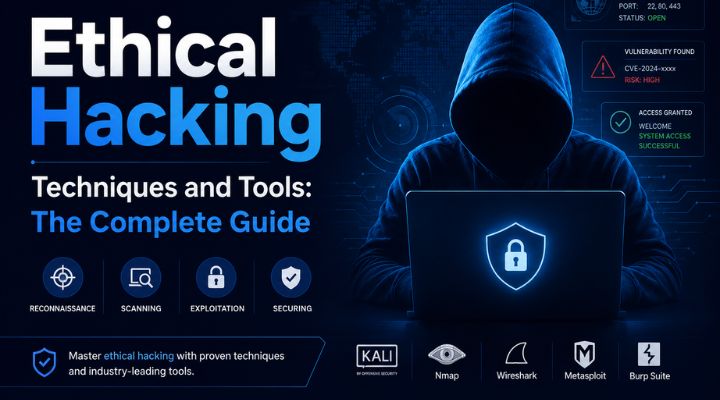
- Reconnaissance — Gathering info about the target (domain details, IP ranges, employee names). Tools: WHOIS, Maltego, theHarvester, Google Dorks.
- Scanning — Mapping live hosts, open ports, and services. Tools: Nmap, Nessus, Nikto.
- Gaining Access — Actually exploiting the vulnerability. Tools: Metasploit, SQLmap, Hydra, Burp Suite.
- Maintaining Access —Installing backdoors or rootkits so the access persists (in ethical testing, this is simulated).
- Clearing Tracks — Removing logs and traces to understand how attackers cover their steps.
The CEH v13 syllabus dedicates roughly 35% of its marks to “Gaining Access” alone, so this phase deserves extra focus during prep.
How to Become a Certified Ethical Hacker: Step-by-Step Guide
Here’s the no-nonsense roadmap, whether you’re 18 or 38.
Step 1: Build Your Foundation Skills
You can’t hack what you don’t understand. Before chasing certifications, lock in these basics:
- Networking: TCP/IP, DNS, DHCP, subnetting, firewalls, VPNs, proxies
- Operating Systems: Linux (Kali, Ubuntu) is non-negotiable. Windows internals too.
- Programming: Python for scripting, plus working knowledge of Bash, JavaScript, and SQL
- Security Fundamentals: Cryptography basics, authentication mechanisms, common vulnerabilities (OWASP Top 10)
Student tip:
If you’re still in college, use free platforms like TryHackMe, Hack The Box (free tier), and OverTheWire.
You can complete the “Pre-Security” and “Complete Beginner” paths on TryHackMe in 2–3 months of consistent effort.
Working professional tip:
Lean into what you already know. A network admin? You have a head start on Step 2. A developer? Web app security is your shortest path in.
Step 2: Meet the Ethical Hacking Eligibility Requirements
Good news first — ethical hacking is one of the few tech fields that cares more about what you can do than what degree you hold. That said, most employers and EC-Council itself expect some formal path:
- Bachelor’s degree in Computer Science, IT, or Cybersecurity (preferred, not mandatory)
- 2+ years of IT/information security work experience (for the self-study CEH route)
- OR complete an official EC-Council accredited CEH training course (which waives the experience requirement)
Can You Become an Ethical Hacker After 12th?
Yes, and here’s the practical path:
- Take up a BCA, B.Tech (CSE/IT), or B.Sc. in Cybersecurity
- Simultaneously build skills through online platforms and CTF competitions
- At 18–20, enrol in a CEH v13 training program through an accredited training center (which also satisfies the exam eligibility)
- Intern with a cybersecurity firm, SOC, or participate in bug bounty platforms while studying
You don’t have to wait until graduation to start. Many successful pentesters began earning through bug bounties while still in college.
Step 3: Choose the Right Certification
Not every cert is worth your money. Here’s an honest comparison:
Certification | Best For | Difficulty | Cost (Approx.) | Recognition |
CEH v13 | Foundation + industry recognition | Moderate | $950–$1,199 | Globally recognised, DoD 8570 approved |
CompTIA Security+ | Absolute beginners | Easy | ~$392 | Good starter cert |
OSCP | Hands-on pentesters | Hard (24-hr practical) | ~$1,499 | Gold standard for pentesting |
CISSP | Senior/management roles | Hard (requires 5 yrs exp) | ~$749 | Top-tier for leadership |
What most career paths look like:
Security+ (optional warm-up) → CEH v13 (broad foundation + hiring signal) → OSCP (to prove hands-on skills) → CISSP (much later, for management).
For freshers and working professionals in India, CEH v13 remains the most employer-requested cert it’s the credential HR teams filter resumes by.
Step 4: Master the CEH v13 Curriculum
CEH v13 is the world’s first AI-integrated ethical hacking certification, released by EC-Council in September 2024. It’s a serious upgrade over v12.
What’s covered:
- 20 modules
- 550+ attack techniques
- 221 hands-on labs (via CyberQ iLabs)
- AI-driven attack and defence modules (genuinely new and heavily tested)
- Cloud security across AWS, Azure, and GCP
- IoT/OT hacking, mobile platforms, cryptography
CEH v13 Exam at a Glance:
- 125 multiple-choice questions
- 240 minutes (4 hours)
- Passing score: 60–85% (EC-Council uses adaptive difficulty)
- Industry pass rate: ~65%
- Certification validity: 3 years (renewable via ECE credits)
Typical prep time is 8–12 weeks for someone with a decent IT background, or 14–20 weeks for complete beginners.
Ready to start?
The Certified Ethical Hacker v13 Program at 3.0 University covers all 20 modules with live labs and satisfies EC-Council’s training-path eligibility — no prior experience required.
Step 5: Get Hands-On Experience (This Is Where Most People Stall)
Theory gets you the cert. Practice gets you the job.
Here’s how to rack up real experience even before your first full-time role:
- TryHackMe & Hack The Box: Solve weekly rooms and machines. Target 50+ completed machines before you start interviewing.
- Bug bounty platforms: HackerOne, Bugcrowd, and Intigriti let you legally probe real companies. Even finding one valid bug is a resume highlight.
- Capture the Flag (CTF) competitions: Events like CTFtime, PicoCTF, and HackTheBox CTFs test you under real conditions.
- Build a home lab: Set up vulnerable machines (Metasploitable, DVWA, VulnHub) inside a VirtualBox environment. Cost: ₹0.
- Internships: SOC analyst internships at Indian firms like TCS, Paladion, eSec Forte, and Kratikal are great entry points.
Real example:
A 2023 bug bounty report on a major Indian fintech app by a 19-year-old college student earned him ₹1.2 lakh plus a full-time offer. That’s the kind of story that’s becoming normal.
Step 6: Build a Portfolio That Actually Lands Jobs
Certifications alone don’t get you hired. A portfolio does. Put these together:
- GitHub profile with your own scripts, tools, and writeups
- A personal blog or Medium where you document CTF solutions and lab experiments
- LinkedIn case studies — short posts about vulnerabilities you found (publicly disclosed or from CTFs)
- Bug bounty reports and acknowledgements from companies
- CTF achievements and HackTheBox/TryHackMe ranks
Hiring managers at mid-to-senior cybersecurity roles openly admit they Google candidates before interviews. A searchable, credible footprint tilts hiring decisions in your favour.
Step 7: Start Applying and Keep Upskilling
Target roles based on your stage:
- Fresher: SOC Analyst (Tier 1), Junior Penetration Tester, Security Analyst
- Mid-level (3–5 years): Penetration Tester, Vulnerability Assessment Analyst, Red Team Analyst
- Senior (5+ years): Red Team Lead, Security Architect, Principal Pentester, CISO track
And never stop learning. The threat landscape reinvents itself every 18 months. 69% of cybersecurity professionals are already testing or integrating AI tools into their security work so adding AI-security depth now is one of the highest-ROI moves you can make in 2026.
Common Mistakes Beginners Make
Avoiding these three traps will save you a year of frustration:
- Skipping networking fundamentals. You can’t exploit what you can’t understand. Master Nmap and Wireshark before any flashy tool.
- Collecting certifications without projects. A person with CEH + 20 CTF writeups gets hired faster than someone with CEH + OSCP + CISSP and zero practical proof.
- Waiting until you’re “ready” to apply. Apply at 70% readiness. You’ll learn more from one interview than a month of YouTube tutorials.
Final Thoughts: Your Next 90 Days
If I had to compress this entire guide into one action plan, it’d look like this:
- Week 1–4: Learn Linux, networking basics, and set up a home lab
- Week 5–8: Complete TryHackMe’s beginner path + start Python
- Week 9–12: Enrol in a structured CEH v13 program, join CTFs
Cybersecurity isn’t a career you “break into” once. It’s a practice you get better at, year after year. And right now with the workforce gap still widening and companies throwing premium salaries at certified talent there’s genuinely never been a better time to start.
Ready to Become a Certified Ethical Hacker?
3.0 University’s Certified Ethical Hacker v13 Program is built for both students and working professionals. You’ll get live training, 220+ hands-on labs, and mentorship from active industry pentesters everything you need to clear CEH v13 and land your first (or next) cybersecurity role.
Want something broader?
Explore the Certification Program in Offensive Cyber Techniques to go beyond CEH into red teaming and advanced threat intel.
FAQs: How to Become a Certified Ethical Hacker
Q1. How long does it take to become a Certified Ethical Hacker?
For someone starting from zero, expect 8–14 months: 3–6 months on fundamentals, 8–12 weeks on CEH v13 prep, and 2–3 months of labs/internships before landing your first role.
Q2. How much does the CEH v13 certification cost?
The exam voucher costs around $950 (remote) or $1,199 (Pearson VUE). Self-study candidates pay an additional $100 eligibility application fee. Training-path students typically pay ₹35,000–₹75,000 depending on the partner.
Q3. Is CEH v13 worth it in 2026?
For entry-to-mid-level professionals, yes — it’s still the most HR-recognised cybersecurity cert globally, it’s DoD 8570-approved, and the v13 update (AI integration) keeps it relevant. For senior hands-on practitioners, OSCP may carry more weight.
Q4. Do I need a degree to become an ethical hacker?
No, but a bachelor’s degree in CS, IT, or cybersecurity helps with initial shortlisting. Certifications + a strong portfolio can compensate if you don’t have one.
Q5. Can I become an ethical hacker without a coding background?
You can start, but you won’t go far. Python is essentially the bare minimum. If coding terrifies you, start there for 2–3 months before touching anything else.
Q6. What’s the difference between CEH v12 and CEH v13?
CEH v13 adds AI-driven attack techniques, expanded cloud/IoT coverage, and hands-on labs powered by CyberQ. The structure (20 modules, 125 questions) is the same, but the AI modules are new and heavily tested.
Q7. Is ethical hacking a good career for women in India?
Absolutely. The cybersecurity field in India is actively trying to improve gender representation, and organisations like WiCyS India, InfoSec Girls, and Breaking Barriers Women in Cybersecurity are driving real opportunities. Skills are gender-neutral — and demand is huge.